
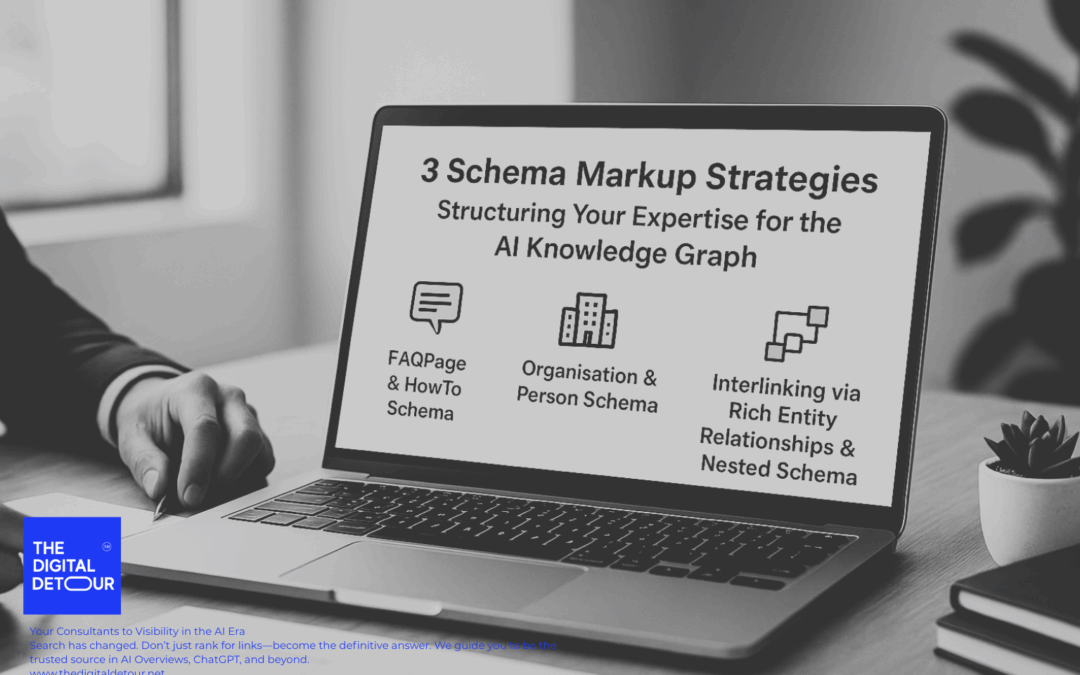
3 Advanced Schema Markup Strategies: Making Your Expertise AI-Quotable
In an era of AI, your content isn’t merely for people and search engines — increasingly, it’s for large language models, knowledge graphs, and AI assistants. To ensure your firm’s proprietary knowledge is machine-readable, quotable, and connected, here are three schema markup strategies that allow you to structure your expertise for the AI knowledge graph.
1. FAQ Page & HowTo Schema — Surface your processes as directly answerable units
Use FAQPage and HowTo schema to encapsulate your frequently asked client questions and stepwise methodologies.
-
FAQPage: Ideal for Q&A sections. Mark up each question and accepted answer so AI systems can pick and quote your responses as standalone units.
-
HowTo: Use this for structured processes, frameworks or “how to do something” content. It allows stepwise instructions to be machine-interpretable.
Implementation tips:
-
Use JSON-LD format (Google’s recommended approach).
-
Only mark up content that is visible on the page (don’t hide markup behind tabs or JavaScript alone).
-
Validate with Google’s Rich Results Test or Schema Validator after implementation.
2. Organisation & Person Schema — Ground authorship and expertise in entity context
To build trust and connect your content to your firm and its practitioners, apply Organisation and Person schema properly.
-
Organisation: Provide structured metadata about your firm—name, logo, website, social links, address, and core areas of expertise. This helps AI systems recognise your firm as an entity in the knowledge graph.
-
Person: Use for authors, consultants, and key contributors. Include name, job title, affiliation (worksFor), and “sameAs” to social or professional profiles. This connects individuals’ expertise to the firm and to the content.
This schema helps AI better recognise who is speaking and which firm is behind the content, increasing chances your insights are attributed correctly.
3. Interlinking via Rich Entity Relationships & Nested Schema
Beyond marking pages individually, you must connect schema entities together so the AI knowledge graph sees the relationships.
-
Nested schema: You can embed Person schema inside Organisation schema, or link FAQPage or HowTo content to the relevant Person or Organisation schema via references (e.g.
@id). -
Entity linking: Use sameAs, url, identifier properties to link your entities to external identifiers (LinkedIn, ORCID, Wikipedia if relevant) or canonical pages on your site.
-
Contextual references: In your JSON-LD, reference related content, services, or case studies through structured relationships, not just hyperlinks. For instance, a HowTo schema might reference the “service offering” schema.
This interconnected structure signals a web of expertise linked to your firm, which AI systems favour when building knowledge graphs.
📌 Practical Guide to Implementation (high level)
| Step | Action | Checklist |
|---|---|---|
| Audit | Identify candidate pages (expert guides, process documentation, FAQs, author pages) | Use site map and analytics to pick high-impact pages |
| Map Schema Types | Assign FAQPage, HowTo, Organization, Person as appropriate | Document which pages need which schema |
| Build JSON-LD | Write schema with required and recommended properties | Use @id for internal linking, sameAs for external links |
| Embed / Deploy | Insert into page <head> or via CMS/custom field |
Ensure visibility and correct syntax |
| Validate & Monitor | Use Rich Results Test, Schema Validator, Search Console | Monitor errors, warnings, and enhancements over time |
| Iteratively Extend | Add more interlinking, nest schema, contextual references | Expand to new pages or deeper relationships |
Why This Matters for B2B / Professional Service Firms
-
AI Quotability: Well-structured schema increases the chance AI assistants will quote your content directly rather than paraphrase generic sources.
-
Entity visibility: Your firm and your experts become nodes in the knowledge graph, enhancing long-term attribution.
-
Search + AI convergence: As generative engines increasingly draw from structured data, your content becomes more resilient to algorithm shifts.
If your web or technical team is ready, I’m happy to provide a JSON-LD starter template or audit your existing schema setup – or we can do all this for you!

Your Guide to Visibility in the AI Era